🏛️ The Ancient Roots: The Sacred Text
There is a profound, almost heavy realization that eventually awakens in the mind of every thoughtful adult child: no matter how hard we try, it is mathematically and emotionally impossible to fully repay our parents for the love, sleepless nights, and quiet suffering they endured to give us a life.
This beautiful, melancholic truth was captured perfectly over a thousand years ago in one of the most famous pieces of classical Chinese literature: “A Son, Departing” (遊子吟).
Written by the Tang Dynasty poet Meng Jiao (751–814) when he was 50 years old, the poem was allegedly penned at the exact moment his elderly, fragile mother finally moved into his home to live out her remaining years under his care. Because of its intense emotional poignancy, it remains a cultural anchor across generations:
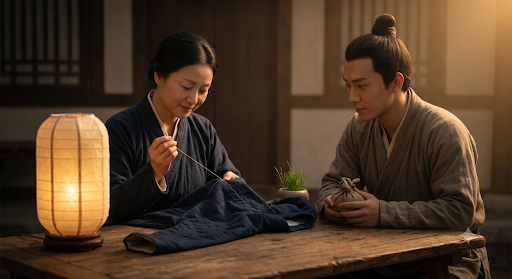
慈母手中線,(A loving mother’s hands hold the thread,)
遊子身上衣;(To sew the clothes for her departing son.)
臨行密密縫,(Before his departure, she stitches them tightly,)
意恐遲遲歸。(Fearing that he will be late to return.)
誰言寸草心,(Who says the tiny heart of a blade of grass,)
報得三春輝?(Can ever repay the warm sunshine of spring?)
The genius of Meng Jiao lies in his heartbreaking central metaphor. He compares the adult child to a tiny, fragile blade of grass, and a mother’s love to the infinite, life-giving spring sunlight.
Just like a blade of grass relies entirely on the sun to grow, survive, and thrive, we owe our absolute existence to our parents. But can a tiny blade of grass ever reach up into the cosmos and give warmth back to the star that sustains it? The answer is devastatingly simple: No. The sun is infinite. It is completely beyond matching.
📜 The Living Legacy: The Stitching of Anxiety
When we are young, we are like that self-involved blade of grass, simply absorbing the sunlight without a second thought. We take the sacrifices for granted because they have always been there.
Look closely at the imagery in the poem’s first lines. Meng Jiao notes that as his mother prepares him for a dangerous, unpredictable world, she channels all her unvoiced anxiety directly into his garment, stitching the threads painstakingly tight (密密縫). She works through the night, her hands moving nimbly, driven by the quiet, terrifying fear that her son might be delayed or harmed on his journey.
In nature, we witness animal mothers endlessly feed and defend their young against all odds. Yet, when the animal mother grows frail and vulnerable, the young never return to defend her; they simply move on.
Humans, however, are gifted with memory, empathy, and the profound art of Childing. It is only when we reach full adulthood that we look back at the “tight stitches” of our upbringing and finally comprehend the staggering weight of the energy poured into us.
🪜 The Map of Consciousness: From Consumer to Shield
To process the reality of this unpayable debt, we must evaluate where we stand on the spectrum of filial devotion:
- The Pitfall (Level -1: Indifference): We look at our parents’ aging process or their repetitive stories as an annoying interruption to our busy modern schedules, leaving their messages “on read.”
- The Baseline (Level 1: Reverence): We recognize the debt. We harbor a deep, internal respect for their sacrifices and hold our tongues out of basic courtesy, even when the generational divide causes friction.
- The Shift (Level 4: Active Reciprocity): We accept that while we can never fully match the sun, we must fiercely try. We step out of the passive role of a “receiver” and actively step into their world—shielding them from modern friction, tech stress, and administrative burdens.
🎴 From Wisdom to Action: Today’s Flashcard Practice
To transform the ancient wisdom of Meng Jiao into a tangible reality in your household today, pull this daily exercise from The Reverence Deck:
🎴 CARD #04: THE UNINTERRUPTED STORY
The Micro-Moment: The next time your parent retells a memory, a piece of advice, or a historical story you have already heard a hundred times before.
The Practice: Consciously choose to pause your internal clock. Do not interrupt them, do not finish their sentence, and do not say “I know, Mom.”
Sit in absolute, unhurried stillness. Look at them with deep presence, and listen to the search for connection beneath their familiar words. Accept the story as a warm ray of spring sunlight, and receive it with a humble, grateful heart.
🛍️ Bring the Practice Home
Want to turn ancient filial principles into concrete, modern habits? Explore our Di Zi Gui Verse Decks and The Eastern Philosophies Collection in our online shop today for structured daily reminders on honoring your roots.